Succession conditions on industrial sites
Ecological succession on post-industrial land follows a broadly recognisable sequence — from bare ground through ruderal pioneer communities to scrub and eventual woodland — but the specific conditions created by industrial use produce local variations that make brownfield succession distinct from succession on agricultural or post-glacial substrates.
Industrial soils frequently combine high mineral content (from construction rubble, demolition material, or mine spoil) with low organic matter, low nitrogen, and in some cases elevated concentrations of heavy metals or hydrocarbons. These conditions favour drought-tolerant, stress-tolerant species that are competitive in nutrient-poor environments. The result is that brownfield sites, despite or because of their often extreme soil chemistry, can support plant communities with substantially higher species diversity than intensively managed agricultural land in the same region.
German researchers working at brownfield sites in the Ruhr, Berlin, and other post-industrial areas have documented this diversity effect over several decades. Sites on coal spoil, on demolition rubble, and on former railway land in particular have been shown to carry diverse assemblages of vascular plants, invertebrates, and in some cases reptile species that are uncommon or absent from surrounding managed landscapes.
Common pioneer species on German industrial land
- Birch (Betula pendula) — early woody coloniser on most substrates
- Rosebay willowherb (Chamerion angustifolium) — widespread ruderal annual
- Buddleja (Buddleja davidii) — neophyte, colonises concrete rubble rapidly
- Oxford ragwort (Senecio squalidus) — spread along railway corridors, found on ballast soils
- Goldenrod (Solidago canadensis) — competitive neophyte on disturbed ground
- Sand lizard (Lacerta agilis) — uses open industrial grasslands for thermoregulation
The concept of Industrienatur
The German term Industrienatur (industrial nature) refers specifically to the spontaneous, unmanaged ecological communities that develop on former industrial land. The concept developed primarily through research associated with the Ruhr region and was given practical policy expression through the IBA Emscher Park process in the 1990s.
The intellectual case for Industrienatur rested on two observations. First, many brownfield sites supported species assemblages and habitat structures that were rare elsewhere in heavily modified landscapes — open mineral soils, sparsely vegetated slopes, warm south-facing rubble banks — conditions that created ecological niches for species dependent on disturbance or stress. Second, the cost of active restoration to prior land use (agriculture, forest plantation) was often high and the ecological outcome unremarkable relative to natural colonisation processes.
This thinking influenced the design decisions at several IBA projects. Landschaftspark Duisburg-Nord, for example, designated substantial areas as "Industrienatur zones" where active management was deliberately withheld. The resulting spontaneous vegetation communities became a documented feature of the park, studied by ecologists from Ruhr University Bochum and other institutions. The Halde Rheinelbe slag heap in Gelsenkirchen represents a further example: the heap has been left to natural succession and now carries a mix of pioneer grassland, scrub, and woodland that is managed primarily by monitoring rather than intervention.
Industrial sites in the Ruhr demonstrated that landscapes shaped by extremes of disturbance and contamination could, under the right conditions, develop into habitats of genuine conservation value without requiring large-scale restoration investment.
Urban brownfield ecology in Berlin
Berlin presents a distinct brownfield succession case shaped by its specific post-war history. Large areas of the city were left undeveloped following wartime destruction, division of the city, and the withdrawal of military and industrial uses. Many of these sites accumulated decades of unmanaged succession before being assessed for development potential after 1990.
Research conducted at Berlin brownfield sites — particularly former railway land such as the Südgelände in Schöneberg — identified ecologically significant communities including extensive populations of orchid species, nationally uncommon grasses, and invertebrate assemblages of regional importance. The Südgelände site was eventually designated a nature reserve (Naturschutzgebiet) in 2000, preserving a core area of spontaneous vegetation within the city while allowing managed public access.
The Berlin experience contributed to a broader shift in German urban ecology, where the ecological potential of spontaneous urban vegetation began to receive policy recognition alongside more conventional approaches to urban green space.
The Ronneburg uranium mining reclamation
The former uranium mining district around Ronneburg in Thuringia presents a large-scale reclamation case from the post-reunification period. The Wismut company, a Soviet-German uranium mining enterprise that operated in East Germany from the late 1940s, left behind a substantial landscape legacy of open pits, tailings ponds, and mine spoil across the Ronneburg area and several other sites in Saxony and Thuringia.
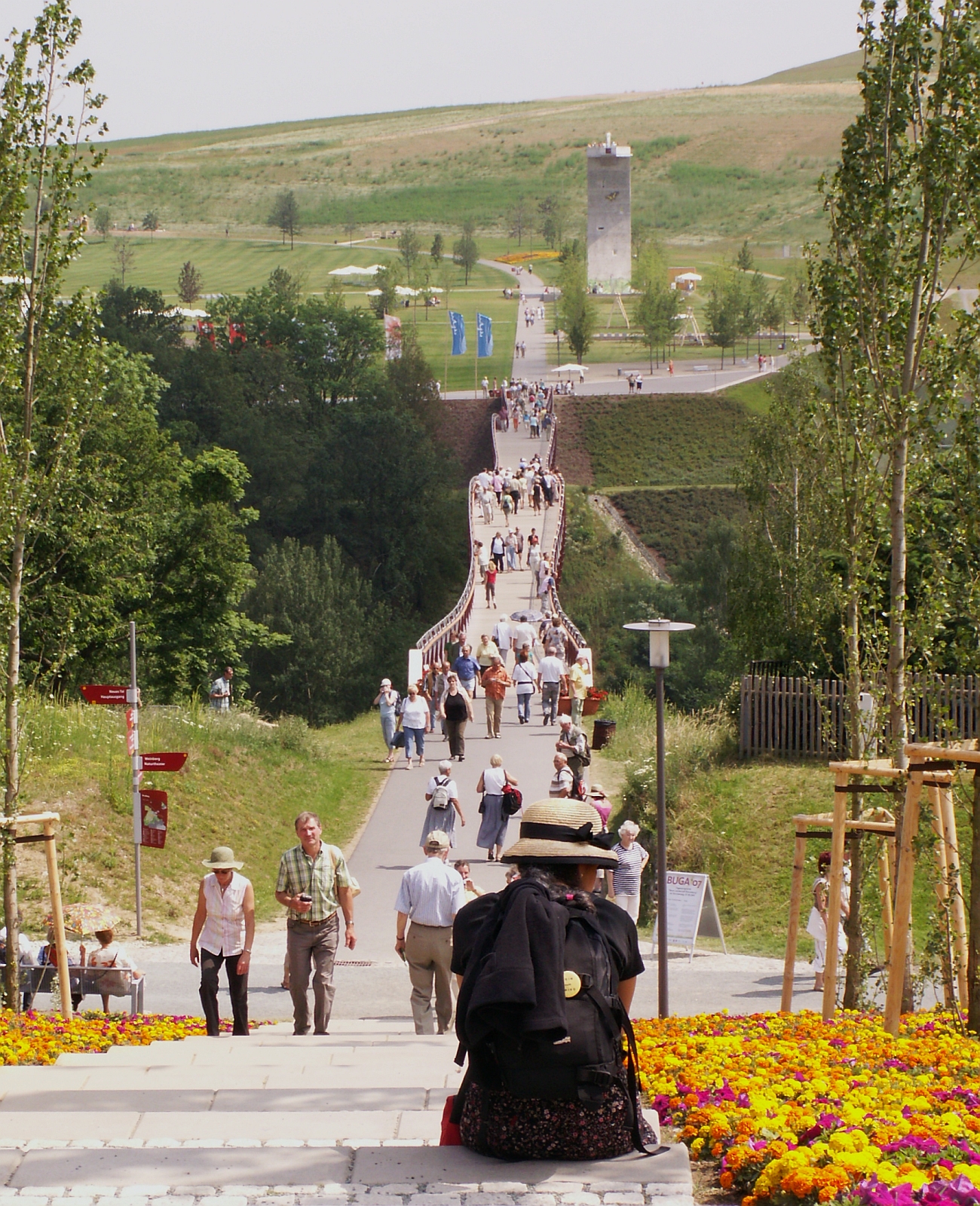
After reunification, a successor federal company (also named Wismut GmbH) was established to manage remediation of the sites. At Ronneburg, remediation involved backfilling the open pit and reshaping the surrounding landscape using spoil material. The site was then revegetated, with the specific aim of producing a landscape suitable for the 2007 Federal Garden Show (Bundesgartenschau), which was held partly on the reclaimed area.
The Neue Landschaft Ronneburg project involved topsoil application, seeding, and targeted planting over the reshaped terrain. The ecological colonisation of the site was documented as part of the post-show monitoring. The Wismut remediation programme at Ronneburg and associated sites is documented by the Federal Office for Radiation Protection (Bundesamt für Strahlenschutz) as a reference case for large-scale radioactively contaminated land remediation in Europe.
Policy and legal context
German nature conservation law (Bundesnaturschutzgesetz, BNatSchG) provides the formal framework within which brownfield vegetation communities can be assessed and, where appropriate, protected. Brownfield sites are not automatically protected, but documented surveys identifying nationally or regionally significant species assemblages can trigger protection requirements under the law's provisions on species protection (Artenschutz) and biotope protection (Biotopschutz).
The Naturschutzgesetze of individual German states (Landesnaturschutzgesetze) add further provisions, and some states have developed specific guidance on the ecological assessment of brownfield sites. North Rhine-Westphalia, with the Ruhr brownfield legacy, has developed extensive administrative experience in balancing development pressures against ecological interest on brownfield land.
The tension between brownfield reuse for housing or commercial development and the preservation of ecologically valuable spontaneous vegetation communities is an ongoing feature of urban planning debates in multiple German cities. The legal and planning tools available to protect brownfield ecology are present in the German framework but require active engagement from conservation agencies and local authorities to be applied consistently.
Monitoring approaches
Long-term monitoring of brownfield succession in Germany has been conducted at several dedicated study sites. The approach typically combines vegetation surveys (following standard German vegetation mapping protocols), soil sampling, invertebrate trapping, and in some cases remote sensing to track succession trajectories over multi-year periods. Research institutions active in this field have included the Ruhr University Bochum (particularly the Vegetation Ecology working group), the Technical University of Berlin, and various Helmholtz research centres.
The data from long-term brownfield monitoring sites has informed both theoretical ecology — particularly research on disturbance ecology, stress tolerance, and the dynamics of novel ecosystems — and applied guidance on brownfield management.